Palm vein unlock has moved from bank and office readers into consumer door locks. For a distributor the question is practical: is it a real benefit for your customers, or just another feature on the box? This article explains the technology without marketing language.
How palm vein recognition works
A palm vein lock lights the palm with near-infrared light. Haemoglobin in the blood absorbs this light, so the veins appear as dark lines in the image taken by the sensor. The lock turns the image into a template and compares it with the templates saved during enrolment. Because the pattern lies under the skin, surface conditions such as dirt or light moisture affect it less than they affect a fingerprint.
Palm vein compared with fingerprint and face
| Fingerprint | 3D face | Palm vein | |
|---|---|---|---|
| What is read | Skin ridges on the finger surface | Face shape, here with structured light | Vein pattern under the palm skin |
| Contact needed | Yes, touch the sensor | No | No, the palm is held in front of the sensor |
| Affected by | Worn, dirty or wet fingers | Angle and distance to the camera | Palm position and distance |
| Typical role | Daily default | Hands-free entry | Extra method for hard-to-read fingers |
Palm vein is best seen as one more way in, not a replacement. The sensible design is a lock that offers several methods, so that a family member whose fingerprints are hard to read can still open the door. For a broader comparison see fingerprint vs face recognition vs palm vein.
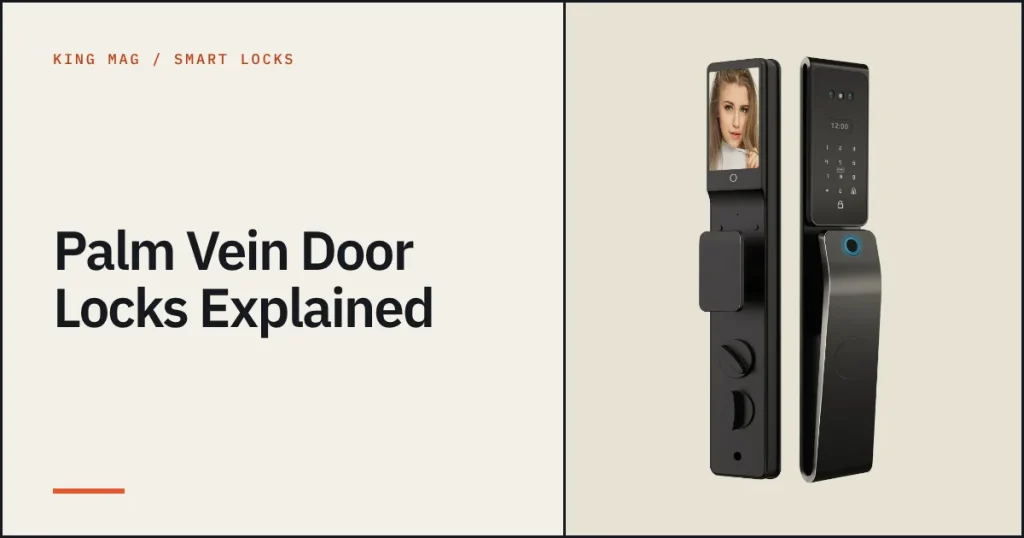
What the HP-01 offers
The HP-01 combines 3D structured-light face recognition and palm vein recognition, with a recognition speed of up to 0.5 seconds as stated on the spec sheet. It also has a semiconductor fingerprint sensor with 0.5-second unlock, password, card, app and remote key. A visual voice call through the built-in microphone, an infrared fill light for night images and a 4200 mAh lithium battery with Type-C emergency power complete the package. It comes in five colours (matte black, matte grey, mocha gold, blue and golden) and is about 425 mm long.
What to verify before you buy any palm vein lock
- Test data. False accept and false reject figures quoted by vendors are manufacturer figures, not independent test results. Ask for the test conditions behind any number.
- Enrolment. How many palms can be stored, and is enrolment guided by voice or screen?
- Template storage. Ask where biometric templates are stored and whether they can be deleted from the lock.
- Fallbacks. Check that a mechanical key and Type-C emergency power exist in case of a flat battery.
- Light and distance. Test enrolment and unlocking at the real door, in daylight and at night.
Our recommendation for importers is to order a sample, test it with a wide range of users and then decide how to position it. Palm vein works as a premium feature when the model also offers fingerprint, face, card and password. contact us on WhatsApp to request the HP-01 spec sheet and sample details.
Frequently asked questions
Is palm vein more secure than fingerprint?
Vendors say vein patterns are harder to copy because they lie under the skin, but published accuracy figures come from manufacturers. Ask for test conditions and use a sample to evaluate real behaviour.
Does the HP-01 only use palm vein?
No. It also supports 3D face, fingerprint, password, card, app and remote key.
Can the lock open if the battery dies?
The HP-01 has Type-C emergency power. Ask us for the details of the emergency options for your version.